Privacy Policy

Monday, 16 May 2011

Is Money a Lousy Motivator?

Here's something to think about. 

Besides the cute animation, Dan Pink (the originator) says that more money actually decreases performance for cognitive tasks. Essentially, he says that money is the wrong kind of motivator. Instead, people want purpose, self-mastery and autonomy! 

Which explains in part why we write these blogs for example, or why people do stuff like learn new languages (which seem to find no immediate usage in their lives). It's for the satisfaction! 

Is it true? And can such ideas be profitable for investors?

Saturday, 7 May 2011

Of Accounting Fraud and China

The Great Wall might well symbolise
the accounting veracity barriers
in China
Image: www.crystalinks.com
Those looking to play the China mega trend would do well to read this from Reuters. Singapore-based investors would be familiar with the tale of the remiss S-chips even though Reuter's perspective is of those listed on the American bourses.

It talks about accounting irregularities bordering on outright fraud, and how even international accounting firms have seem to fail to detect these, leaving it to certain smaller research firms to investigate and then short the companies profitably (which also spells another conflict of interest and gives potential room for abuse). 

1: For any firms (including those outside of China) where the financial statements cannot be depended upon to be reliable, the only thing  for an investor to do is to avoid it like the plague, regardless of how profitable the trade might seem. The reason might be obvious, but let me say it loud and clear: If the financial statements are not reliable, there is no means of knowing what is going on in the business, unless you are an insider.

2: Reputation is actually worth something. This doesn't mean that one should only invest in well-known firms, indeed great opportunity might lie in small unknown firms. But then there might be a need for a larger discount factor to take into account any unknown risks. Or to put it another way, the expected profits from such less known investments should be fairly large, to compensate for the higher "risks".

3: Another point to note from the Reuters' article is, for those Chinese firms that are formed out of reverse mergers, they did not undergo the rigours of the American IPO process, which thus give rise to such abuses. 

4: There are other ways to play China than to invest directly in the country's companies. International firms doing business in China, or selling their products in China (or for that matter the other countries in rapidly growing countries), can be a safer way to get the China exposure, without the Chinese accounting issues.

Friday, 6 May 2011

2011's Fortune 500 Companies

Image: Fortune Magazine
So the Fortune500 list for 2011 is out. 

For me, such lists can be useful and interesting, as it can be a good place to start looking for investment ideas, and to stimulate some thoughts on whether there are value investment opportunities among America's largest companies.

Big can be good if it implies a level of safety (as in, it is unlikely to go bust, though that can obviously prove otherwise which explains why further work is needed, think Lehman Bros or Enron) or dominance (e.g. Walmart, or Big Oil). So, happy trawling over the list.

Wednesday, 4 May 2011

China: A Bundle of Contradictions?

Image: Knowledge@SMU
Some of you may be wondering why I have been posting all these links to Knowledge@SMU. In addition to there being some gems on the website, I also have been a contributor and the articles I have posted so far have been written by me (though I might post some others in future not written by myself).

Investors in China have rode some fast and furious bull runs and equally heart-stopping falls, and they might wish to pay heed to the huge and potentially devastating effects of the unsustainable amounts of local government debt, which might ultimately require a bailout not unlike that of the bank bailout in the developed world. 

Carl E. Walter and Frasier J.T. Howie sound off warning bells in their book entitled Red Capitalism, which talks about the near-incestuous relationship between the mega- State Owned Enterprises (SOEs) and the government, and how China's banks are practically "state utilities" to be turned on and off by the central government. 
They warn that "“one cannot simply assume that words such as ‘stocks’ or ‘bonds’ or ‘capital’ or ‘yield curves’ or ‘markets’ have the same meaning in China’s economic and political context” than that understood in international finance. They highlight the need to look beyond the curtain to glimpse the rot beneath and discern the true flows of capital in this so-called economic miracle."
 Read the full review here.

Monday, 2 May 2011

Does Diversification and Market-Timing Make Sense?

It has been a busy week, Singapore is having its General Elections, and given my stake and ownership in this country, I have been focusing on that. 

Nonetheless, here's an interesting video from Forbes on a fund manager who talks about diversification and market timing. None of it is original wisdom, but investors might want to take heed on the wisdom of diversification and the folly of timing. 

Or not? It's a tough question, almost 2 camps of people with opposing views. My take is, non-professionals should diversify, in fact just use an index fund, and forget about timing, if they have a long horizon (those who don't are best served through just remaining in money market assets). But well, many others would suggest otherwise.  


Watch this, for another viewpoint.

Saturday, 30 April 2011

Some Thoughts on Foreign Currency Time Deposits

Image: www.businesscafeonline.com
A friend asked me this question:
What is your view of RMB time deposit offered by bank of china? The offer is found here.

My answer is: Dear Mr. A,
I had a brief look at what the offer is. I can't say I know too much about currencies and of this specific deal. And what I am about to say, might be factors that might be already obvious to you. But here goes:
You are taking on 2 main exposures by doing it. 

First, currency exposure, i.e. the fluctuation of the RMB versus your home currency (I presume you are thinking of changing SGD to RMB, but it could also be USD/RMB or some other currency pair). 

The appreciation or depreciation of a foreign currency depends on a few factors, which are affected by macro-economic policies which might be unforeseeable, and also the relative strength of the 2 economies, their interest rate differential and their inflation rate differential (this is actually Fisher's interest rate parity theorem). And of course if the current pricing is inefficient, then there are also sentiment driven factors. But let's assume the currency market is efficient (in the parlance, we'd call that the null hypothesis), which it likely is, since the currency market is one of the most liquid, if not the most liquid market in the world. 

Where any of these factors are going, and the relative strength of it versus Singapore is hard to predict, and the interaction of the factors are complex. So, you have to ask yourself whether you believe that the RMB is going to appreciate against the SGD. If it depreciates instead, it could offset the yield that you were getting from the RMB time deposit.

Disclosure: My experience in forex is limited, I have used currency swaps structured similar to forex time deposits before, as I was posted aboard for a period, and of course the usual forex transactions when travelling. I currently have no direct or derivative positions on forex but have foreign asset holdings denominated in foreign currencies and some tiny amounts of paper currencies.

Friday, 29 April 2011

Is Microsoft a Good Value Play?

Image: Microsoft
Microsoft used to be THE company everyone loves to hate (now it's the banks), complaining about its blue screens of "death" and just disliking its dominance of the PC market. 

Today, MSFT seems almost like a lost cause, having floundered for 10 years with its share price going nowhere. With its PE ratio this cheap (10.4x trailing twelve months), coupled with strong cashflows, MSFT is a monopoly priced like a sunset industry. 

With its products spanning a wide range from the X-box for the gaming crowd, to its ubiquitous Windows OS and Office suite for the business people, and consumers too, MSFT seems extremely cheap for what is among the most universal of all brands and products. And we haven't even factored how it might dominate in cloud, which is lauded as the next big thing. Is MSFT a good value-play? 

DR Horton: Buy, Hold or Sell?

If you want to play the housing recovery theme, first read the post that's just before this one.

If stocks are your favoured instrument, one place to start is to examine the major homebuilders in the USA and examine which among them is best managed and positioned to ride this potential recovery. 

Image: Dr Horton
The biggest among them is worth investigating - DR Horton (NYSE: DHI). With its operations spanning the entire continental USA, its use of land parcel options to hedge its  purchases for its land portfolio, and its decent financials, DHI is well positioned to benefit from an upturn. The land options are real options, i.e. they are not financial derivatives but ones that involve the receipt of actual plots of land and can be viewed as call options.

However, if the housing market double-dips or crashes, DHI would naturally follow the industry's downturn. So first decide if housing is going to make a comeback (which it has not yet failed to do before since we actually all need housing and not "eyeballs" or tulips), or not.

Disclosure: I have direct holdings in DHI.

I use the term direct holdings because for some companies, I might have indirect holdings for example in an indexed ETF. I do not use derivatives, though I might in future. A direct holding is a very specific investment or "bet" and stockpicking is not for those not versed in financial analysis. 

A widely diversified ETF or mutual fund might be a better instrument for those wanting to ride with the market, or even to play specific sector themes. In this case, housing sector ETFs are available, but as with all investments, you should conduct your own research to determine its suitability for your portfolio.

Thursday, 28 April 2011

Contrarian on Housing?

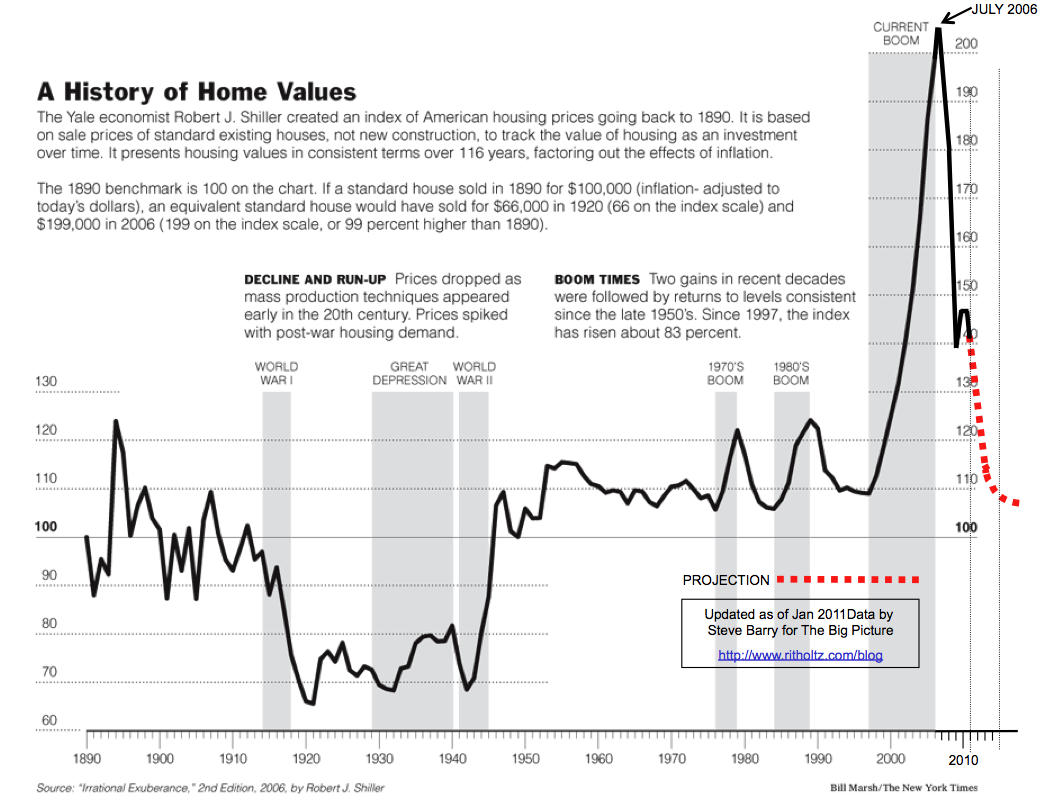
For those considering a contrarian play on housing in the US market, you might do well to read this on Seekingalpha.com. It discusses whether you should use physical real estate or homebuilder stocks as your instrument and its pros and cons.  

Mean Reversion?
Source: Seekingalpha
The real difficulty of being contrarian is that while it might seem obvious as a "fantastic" opportunity on hindsight if homebuilder stocks see a strong recovery on the back of an improving housing market, there are also 1001 reasons why there might not be such a great recovery, all seemingly very logical. 

It never is easy being contrarian, which is why while everyone knows the dictum to buy low and sell high, or Warren Buffet's famous phrase, "be fearful when others are greedy and be greedy when others are fearful" seems like a truism, it is actually extremely difficult to execute.